
In this article
What happens if rain changes your outdoor wedding ceremony?
An outdoor ceremony can be absolutely brilliant. Nice setting, everyone relaxed, plenty of space and, when the weather plays ball, it can feel far less formal than being shut inside a room.
The obvious problem is that we are in Britain. A forecast saying dry at breakfast does not mean very much by two o'clock.
I have no issue at all with couples planning an outdoor ceremony. I would just never plan one without knowing exactly what happens if the weather changes.
Decide on the wet-weather room before the wedding day
The worst plan is: "We will see what happens."
That sounds flexible, but it usually means nobody knows where the chairs are going, where the registrar or celebrant will stand, where the musicians can set up or how quickly guests can be moved.
Ask the venue what the actual backup space is. Go and look at it if you can. It does not need to be your first choice, but you should be happy enough with it that moving indoors does not feel like the wedding has suddenly gone wrong.
It is also worth asking who makes the final decision. Some venues will decide several hours beforehand because chairs, flowers and equipment need moving. Others can leave it much later. Knowing that in advance avoids a lot of unnecessary stress.
Think about the musicians as well as the guests
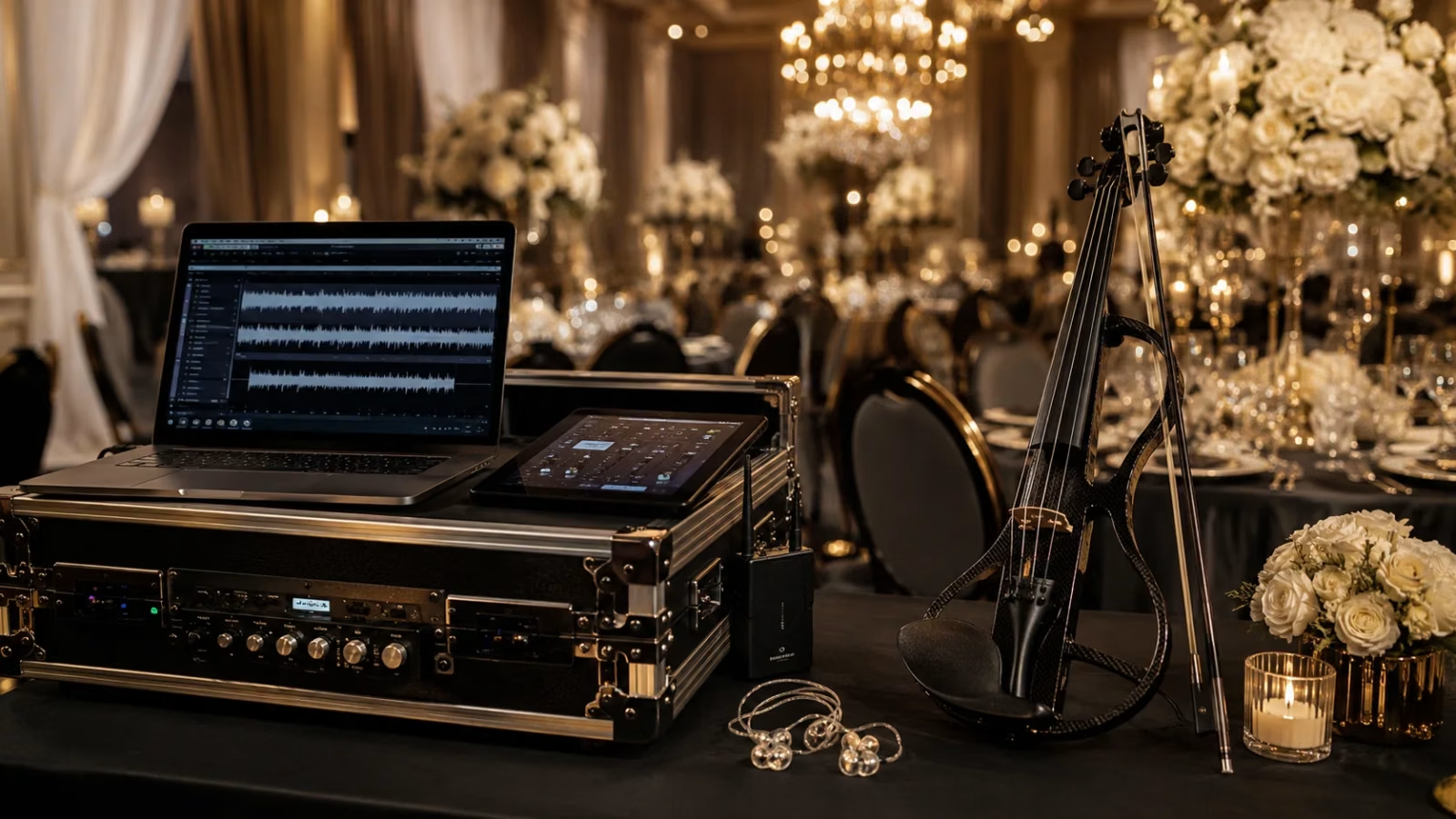
A violin is not improved by rain. Neither is an amplifier, mixer, laptop, speaker or any of the other equipment that may be involved in live music.
A little drizzle that guests are happy to sit through can still be completely unsuitable for electrical equipment. Wind can be just as troublesome. Music stands become sails, microphones pick up gusts and even a covered area can become wet if the rain is blowing sideways.
If live music is part of your ceremony, the sensible question for the venue is not simply "Is there cover?" It is:
- Is the cover genuinely weatherproof?
- Is there a dry route to get equipment there?
- Is power available safely?
- Is there enough room to perform without blocking the ceremony?
- Can the same setup be moved indoors quickly if needed?
Those are boring questions right up until the point that they matter.
The music itself usually does not need to change
The good news is that a move indoors rarely means changing your song choices.
If you have chosen a particular entrance piece, signing music and an exit song, I can normally use exactly the same plan in the backup room. The difference is mostly practical: volume, positioning and timing may need adjusting to suit the new space.
A smaller indoor room often needs much less amplification than an outdoor ceremony. In some rooms the natural acoustic does a lot of the work. That is one of the advantages of having somebody there who can react to the room rather than relying on a fixed playlist at a fixed volume.
Give the entrance route some thought
This catches people out.
The outdoor aisle might be long and dramatic. The indoor backup aisle might be twelve seconds from door to front row. If your chosen entrance has a long introduction, the timing suddenly becomes very different.
That is not a reason to choose a different song. It is simply something the musician needs to know. A live arrangement can usually be started at a more useful point, extended, shortened or brought to a musical finish once everybody is in place.
The same applies if the wedding party is entering in stages. Tell your musician how many people are coming in and whether you want one piece or separate pieces. That information is far more useful than an instruction like "play for about three minutes".
Do not wait until everybody is already soaked
If the weather is marginal, make the decision with enough time for suppliers to move properly.
Dragging speakers, cables, flowers and chairs through rain while guests are arriving is not a good start to a ceremony. Nor is setting everything up twice because nobody wanted to make the call.
There is nothing disappointing about using the wet-weather plan if it is a good plan. What feels disappointing is a panicked last-minute compromise.
A good Plan B should still feel like your wedding
This is really the point.
You do not need to spend the week before the wedding refreshing four weather apps every ten minutes. Have the outdoor plan you want, have an indoor plan you are happy with, and make sure the suppliers know both.
Then, if the sun comes out, brilliant. If it rains, everybody moves inside, the same music starts, you get married, and the day carries on.
That is exactly what a backup plan is supposed to do: remove the drama from something you cannot control.